Sea Moss Knowledge Hub
The History of Sea Moss: From Caribbean Tradition to Modern Superfood
The history of sea moss is older, richer, and more surprising than most people realize. Long before sea moss became a wellness trend or a TikTok staple, communities on opposite sides of the Atlantic Ocean were quietly relying on this remarkable ocean plant for nourishment, medicine, and survival. Understanding where sea moss came from — and the centuries of cultural knowledge embedded in its use — helps explain why it deserves serious consideration as part of a modern wellness routine. This is not a fad. It is a tradition finally getting the attention it was always due.
Ancient Irish Roots: Carrageen Moss and the Original Seaweed Tradition
The documented Western history of sea moss begins on the rocky intertidal coastlines of Ireland, where Chondrus crispus — commonly called carrageen moss or Irish moss — has been harvested for at least 600 years. Historical records indicate that coastal Irish communities were collecting this red algae as early as the 14th century, though oral tradition and archaeological evidence suggest the practice is considerably older.
For these communities, carrageen was not a supplement or a luxury. It was food — free, abundant, and nutritionally meaningful. Growing in dense mats on exposed rocks in the intertidal zone, the algae could be harvested by hand, dried on flat stones in the wind, and stored for months without refrigeration. When boiled in water or milk, dried Irish moss released its polysaccharides into the liquid, creating a thick, nourishing gel that could be sweetened with honey or spiced with cinnamon. It was consumed as a warming winter drink, fed to sick children as a restorative, and used as a thickening base for broths and desserts.
The most sobering chapter in the history of Irish sea moss use is the Great Famine of 1845–1852, when the potato blight destroyed Ireland's primary food source and triggered a catastrophic humanitarian crisis. For coastal communities, carrageen moss provided a critical nutritional lifeline. Those who knew how to harvest and prepare it had something to eat when almost nothing else remained. The resilience this represents — turning to the ocean during the worst years of famine — is a testament to the real nutritional density that modern science has since confirmed.
By the 19th century, carrageen had attracted the interest of physicians, who prescribed it for coughs, bronchitis, and gastrointestinal inflammation. Its naturally gelatinous quality made it soothing for irritated mucous membranes. By the late 1800s, carrageenan — the polysaccharide extracted from Irish moss — had found industrial applications as a food thickener and emulsifier, roles it continues to fill in the modern food manufacturing industry in products ranging from dairy desserts to infant formula.
Caribbean Folk Medicine: A Parallel Tradition Across the Ocean
While Irish communities were developing their relationship with carrageen moss on cold northern shores, a parallel tradition was taking shape in the warm, clear waters of the Caribbean Sea. Species in the genus Gracilaria and related red algae thrive in the shallow coastal waters of Jamaica, Trinidad, Barbados, Saint Lucia, and throughout the Lesser Antilles. Island communities developed their own traditions of harvesting and using sea moss across generations — traditions that predate written documentation but are no less real or significant for that.
In Caribbean folk medicine, sea moss was understood primarily as a tonic: a restorative food given to the sick, the elderly, the malnourished, and those recovering from illness or childbirth. Community healers prescribed it for respiratory infections, kidney complaints, and as a general fortifier. Mothers fed sea moss preparations to children who were failing to gain weight. The substance was considered strengthening in a deep, mineral sense — not a cure for any specific disease, but a means of building the foundation of health that allows the body to heal itself.
Preparation varied by island but centered on a consistent method: fresh or dried sea moss was washed thoroughly, soaked overnight in fresh water to rehydrate, then blended or slow-boiled with water, lime juice, cinnamon, and sweetened condensed milk or coconut milk. The result was a thick, creamy, gently spiced drink — filling, warming, and considered particularly restorative for anyone who had been depleted by illness, overwork, or inadequate nutrition.
This is the direct ancestor of the sea moss gel tradition that continues today. When you blend soaked, wild-harvested sea moss with water and refrigerate the resulting gel, you are participating in a practice that Caribbean communities have followed for generations. The method has been refined, the flavors expanded, and the scientific understanding deepened — but the underlying intuition is identical.
The Jamaican Irish Moss Drink: Where Two Cultures Met
One of the most interesting chapters in the history of sea moss is the collision of Caribbean and Irish traditions in Jamaica. During the colonial period, Irish laborers and indentured servants arrived in the Caribbean carrying their knowledge of carrageen moss — and discovered that the local population was already using a remarkably similar plant in almost identical ways. The convergence produced something uniquely Caribbean: the Jamaican Irish Moss drink.
Sold by street vendors, mixed at rum bars, and prepared in home kitchens across the island, the Jamaican Irish Moss drink combined Caribbean sea moss with spices like nutmeg, cinnamon, and vanilla, and was often mixed with stout or porter for an adult tonic version, or with condensed milk for a rich, dessert-style drink. It became embedded in Jamaican cultural life as both a genuine health tonic and — more colorfully — a substance credited with enhancing energy and vitality, a reputation that contributed significantly to its lasting popularity.
The Jamaican Irish Moss drink is still sold throughout the Caribbean and in Caribbean diaspora communities in New York, Toronto, London, and Miami. It occupies that rare cultural space where folk medicine, community identity, and pleasure all overlap — a liquid tradition that has crossed oceans twice and endured for centuries. When you taste sea moss gel today, you are tasting something with that depth of history behind it.
Dr. Sebi and the American Awakening
For most of the 20th century, sea moss remained largely invisible to mainstream American wellness culture. It was consumed within Caribbean immigrant communities in East Coast cities, used as a food additive under the name "carrageenan," and occasionally referenced in alternative health literature — but it had not broken through to a wider public. That began to change through the teachings of Alfredo Darrington Bowman, known as Dr. Sebi.
A Honduran-born herbalist and self-taught healer, Dr. Sebi developed an "African Bio-Mineral Balance" dietary philosophy centered on alkaline foods, plant-based nutrition, and the elimination of hybrid, processed, and acidic foods. Sea moss held a prominent position in his nutritional philosophy. He described it as containing most of the minerals that compose the human body — a figure that became one of the most widely cited claims in the sea moss wellness community.
Dr. Sebi's teachings spread through decades of lectures, community workshops, and word of mouth, particularly within Black American and Caribbean communities who recognized echoes of their own folk traditions in his work. His methods were frequently at odds with conventional medicine, and he attracted considerable controversy during his lifetime, but his influence on how people in these communities thought about plant-based mineral nutrition was undeniable. When he passed away in 2016, his teachings were already circulating rapidly online.
Celebrities who publicly credited Dr. Sebi's protocols helped amplify his reach further. As his YouTube videos and blog interpretations of his work spread, sea moss became increasingly associated with serious, intentional health practice — not just among Caribbean communities, but across a growing wellness audience that was hungry for whole-food, mineral-rich nutrition.
The TikTok Boom: Sea Moss Goes Mainstream
The final and most explosive acceleration in sea moss's rise came through social media, and specifically through TikTok. Between 2019 and 2022, sea moss content proliferated across platforms. Videos of people making sea moss gel at home, blending it into smoothies, or combining it with bladderwrack and burdock root (a combination derived from Dr. Sebi's protocols) accumulated tens of millions of views. The hashtag #seamoss became one of the most-followed wellness tags on the platform.
The timing was not coincidental. Sea moss entered social media consciousness at precisely the moment that several major wellness trends were converging: the plant-based nutrition movement, the gut health revolution, the mineral supplement market, and a growing consumer desire for whole-food alternatives to synthetic vitamins. Sea moss addressed all of these simultaneously — a single, natural, food-form substance offering a broad spectrum of minerals, prebiotic fiber, and nutrients that the body recognizes and can use efficiently.
When athletes and celebrities began discussing sea moss publicly as part of their recovery and performance routines, search volume spiked dramatically and the supplement industry responded at speed. By 2022, the sea moss gel market had expanded from a small, community-driven niche into a significant wellness category with dozens of competing brands.
That rapid growth introduced predictable quality problems. As demand outpaced the supply of genuinely wild-harvested Caribbean sea moss, many brands turned to pool-grown or tank-cultivated sea moss — a faster and cheaper production method that produces algae with significantly lower mineral density than ocean-grown equivalents. Others cut costs on flavoring by substituting synthetic "natural flavoring" additives for actual fruit. Quality control became inconsistent. The market became crowded with products that traded on the sea moss name without delivering the quality that the centuries-long tradition demands.
Why the History of Sea Moss Matters When Choosing a Brand
Understanding the history of sea moss is not merely an academic exercise. It matters practically, because it clarifies what sea moss is supposed to be: wild-harvested, ocean-grown, prepared with real whole ingredients, and free from industrial shortcuts.
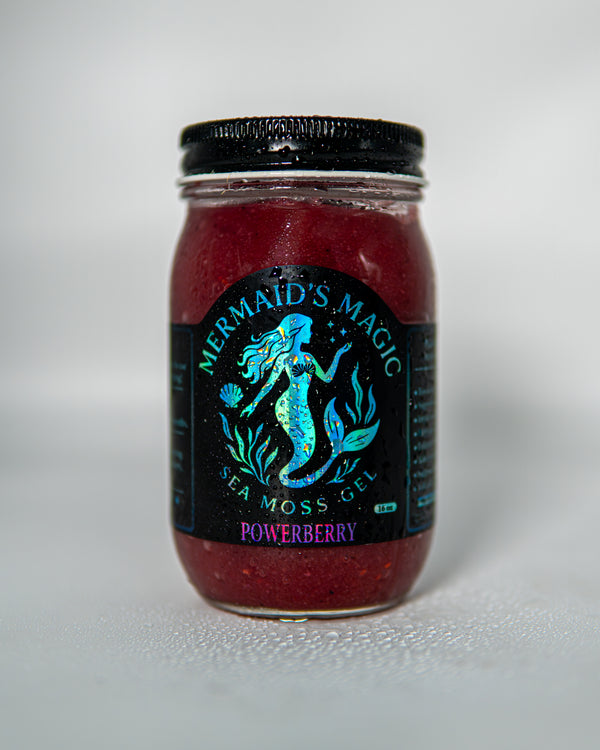
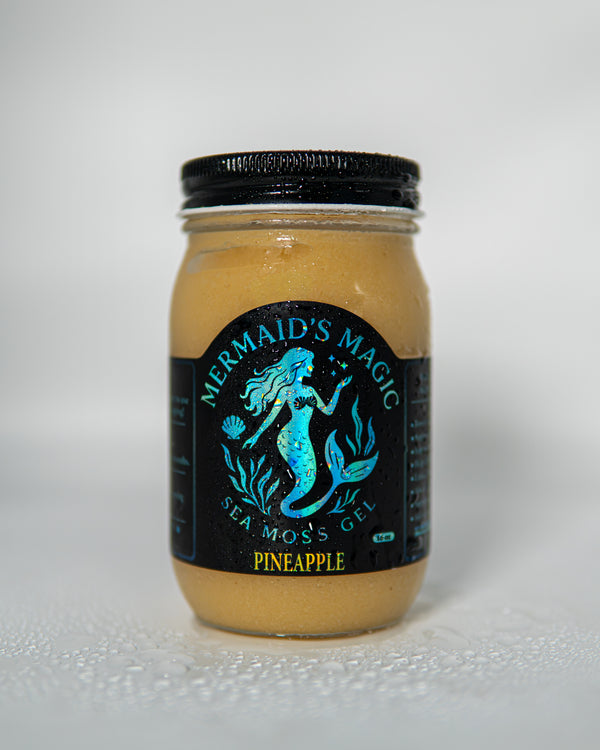
At Mermaid's Magic Sea Moss, every jar we produce reflects that original standard. We source only wild-harvested Caribbean sea moss — gathered from clean, open Atlantic waters, not cultivated in tanks. When we flavor our gels, we use real whole fruit: actual strawberries, actual pineapple, actual mango, actual blueberries. Not juice concentrates. Not "natural flavoring" — a labeling term that can legally apply to a wide range of manufactured compounds that bear no meaningful relationship to the fruit named on the label.
This is not a marketing position. It is the continuation of a tradition that stretches from Irish coastal communities through Caribbean folk medicine through Jamaican market stalls to the farmers markets of Northwest Florida where we sell our products directly, face to face, to the people who will be nourishing themselves with what we make. The people who relied on carrageen during the Famine were not using concentrates. The Jamaican grandmothers who made Irish Moss drinks were not using artificial flavoring. They were using the real thing.
For a deeper look at what to watch out for in the modern sea moss market, read our breakdown of real fruit versus natural flavoring in sea moss gel.
The Future of Sea Moss: Science Catching Up to Centuries of Tradition
The arc of sea moss's history follows a familiar pattern: communities observe and use what works, science eventually investigates, and traditional wisdom is largely validated. We are currently in the early phases of that scientific validation period for sea moss.
Research into the bioactive compounds in red algae — including sulfated polysaccharides, fucoidan, fucoxanthin, and the mineral profiles of wild-harvested species — is accelerating. Studies catalogued through the National Library of Medicine's PubMed database are exploring sea moss's potential roles in gut microbiome support, immune modulation, thyroid function, glycemic control, and metabolic health. The science is preliminary in many areas, but the direction is consistent with what folk practitioners have been observing for centuries.
The sea moss industry is maturing, too. Consumers are asking harder questions about sourcing, ingredients, and transparency. The brands that earn long-term trust will be the ones doing the work honestly — wild-harvesting from clean waters, using real ingredients, and standing behind their products with genuine accountability.
Sea moss has survived famine, crossed oceans twice, endured generations of folk transmission without the benefit of written records, been championed by controversial healers who saw what conventional medicine was missing, and exploded across the social media platforms of the 21st century. That is a remarkably durable tradition. Traditions that durable tend to be rooted in something real.
Experience the Tradition for Yourself
Centuries of ocean wisdom, wild-harvested from Caribbean waters, blended with real whole fruit — no concentrates, no shortcuts, no "natural flavoring" tricks. This is sea moss the way it was always meant to be.
Keep Reading
- What Is Sea Moss? The Complete Beginner's Guide to This Caribbean Superfood
- How to Use Sea Moss Gel: 10 Easy Ways to Add It to Your Daily Routine
- 15 Science-Backed Sea Moss Benefits You Need to Know
- How to Store Sea Moss Gel (And How Long It Actually Lasts)
Ready to try sea moss? Shop our fruit-infused sea moss gel collection — made with real whole fruit, wild-harvested Caribbean sea moss, and nothing artificial.